AI UGC Video Ads: How to Make and Sell Them in 2026 (Prices, Tools and Rules)
 Falah Hassan
•
•
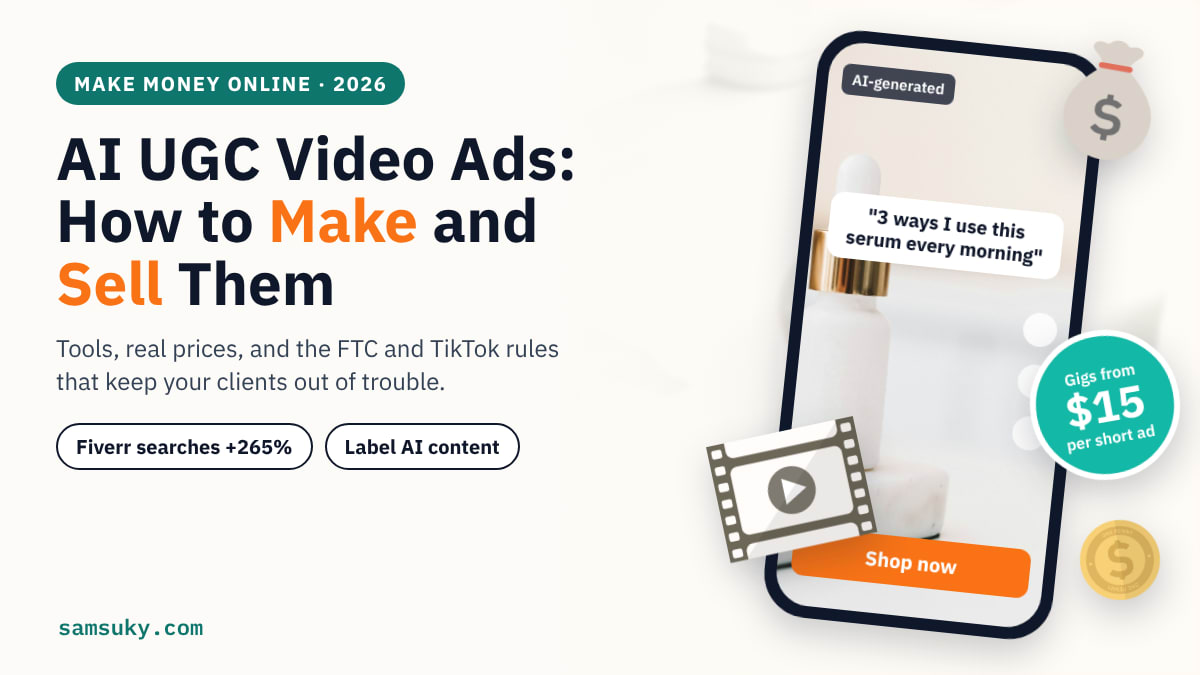
AI UGC video ads are short, phone-style ads that look like a regular person talking about a product, but they are made with AI tools: an AI voice, an AI avatar or AI-generated scenes, mixed with real shots of the product. Brands love them because one video can be ready in hours instead of waiting a week for a creator to film it, and they can test five different hooks for the price of one shoot.
Demand is real. In Fiverr's Business Trends Index (June 2026), searches for "AI UGC video ads" were up 265%. This guide shows how to make AI UGC video ads step by step, what to charge, where to sell them, and the rules from the FTC, TikTok and Meta that you must follow so your clients' ads don't get rejected or land them in legal trouble.
Came from video #14? You're in the right place. See all video guides →
What is an AI UGC video ad?
"UGC" means user-generated content: videos that feel like they were filmed by a normal customer, not a studio. Classic UGC ads use real creators who film themselves with the product. AI UGC keeps the same look (vertical 9:16, a face or voice talking to the camera, captions, quick cuts) but replaces some or all of the filming with AI.
A typical AI UGC ad is 15 to 30 seconds long and has four parts: a hook in the first two seconds, one clear benefit, a short demo or proof, and a call to action ("Shop now", "Try it free").
How to make AI UGC video ads: the 5-step workflow
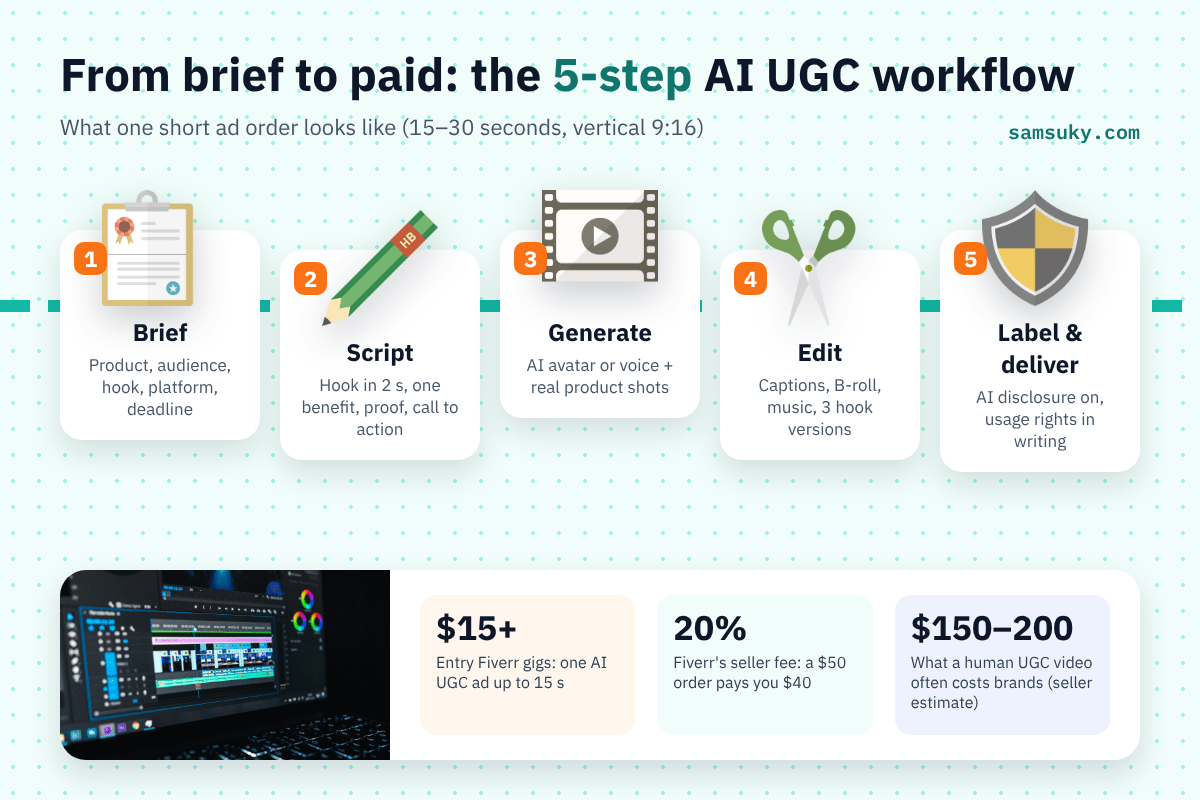
- Get a clear brief. Ask the brand for the product, the target buyer, the platform (TikTok, Instagram Reels, Facebook), the main benefit and any claims they are legally allowed to make. Ask for real product photos or a sample.
- Write the script. Hook (a question or a surprising line), one benefit, one proof point, call to action. Keep it to 40-70 words for a 15-30 second ad. Write 3 different hooks: brands want to test them.
- Generate the video. Use an AI avatar or talking-presenter tool, or an AI voiceover over real product footage. Many sellers combine both: AI voice plus real hands-on product shots.
- Edit. Add big captions, B-roll, a light music bed and fast cuts every 1.5-3 seconds. Export 1080x1920.
- Label and deliver. Turn on the platform's AI-generated label (or add a clear "AI-generated" caption), and write down the usage rights: where and for how long the brand may run the ad.
Tools people use (pick one per job)
- Script: any AI chat assistant (see our ChatGPT vs Claude vs Gemini comparison).
- Voice: AI voice generators such as ElevenLabs.
- Avatar or scenes: AI avatar apps (HeyGen, Arcads and similar) or video models like Google Veo.
- Editing and captions: CapCut or any editor you know. More options in our list of free AI tools for short videos.
Check each tool's current plan before you sell: some free plans do not allow commercial use or add a watermark.
How the money works (with real numbers)
Prices on Fiverr vary a lot. In November 2026 we found entry-level AI UGC gigs starting at about $15 for one edited ad of up to 15 seconds with captions and 3 months of usage rights. Sellers often compare this with human UGC creators, who they say charge around $150-$200 per video (a seller's estimate, not an official figure).
Worked example: Fiverr keeps 20% of every order. If you sell a 3-ad package for $60, you keep $48. Ten such orders a month = $480. If you instead land one direct client (no platform fee) at $300 a month for 8 ads, you keep the full $300. Most sellers start on Fiverr for reviews, then move repeat clients to direct monthly packages.
What to put in your packages:
- Basic: 1 ad, 15 s, captions, 1 hook.
- Standard: 1 ad, 30 s, 3 hook versions (brands love A/B testing).
- Premium: 3 ads, 3 hooks each, square and vertical exports, 6 months usage rights.
The rules: what you can and can't sell
This is the part most "make money with AI UGC" videos skip, and it is the part that protects you.
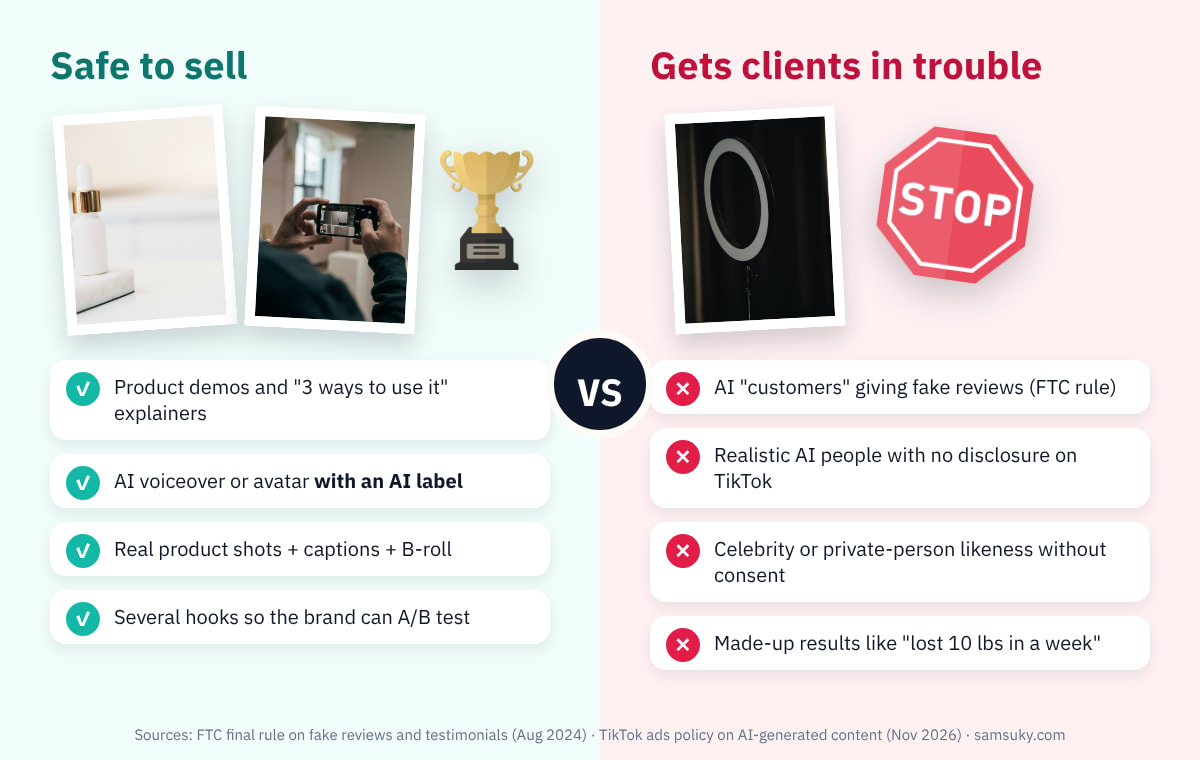
- FTC (United States): the FTC's final rule on fake reviews and testimonials (announced August 2024) bans reviews or testimonials that pretend to come from someone who does not exist, including AI-generated fake reviews, or from someone with no real experience of the product. The FTC can seek civil penalties against knowing violators. So an AI "customer" saying "I used this for a month and it fixed my skin" is a fake testimonial.
- TikTok: TikTok asks creators to label AI-generated content that contains realistic images, audio or video. Its ads policy (updated November 2026) says ads with AI-generated or significantly edited content must use the AI label or a clear disclaimer, caption, watermark or sticker, and undisclosed AI content will be rejected or restricted. Using a public figure's likeness without permission is not allowed.
- Meta and YouTube: both now show "AI info" or similar labels on ads made or significantly edited with AI, and YouTube requires creators to disclose realistic synthetic content.
The safe way to sell: make AI UGC as a presenter or demo ("3 ways to use this serum", "here's how the app works"), not as a fake customer review. Only use claims the brand can prove, label AI, and never copy a real person's face or voice without written consent.
What sells best
- Skincare, beauty and wellness products (with careful, provable claims).
- Apps and software: screen recordings + AI voice explaining the feature.
- Dropshipping and Shopify stores that need many ad variations fast.
- Local businesses: restaurants, gyms and clinics that never had video ads.
Want more AI services to bundle? See our guide to Fiverr gigs you can sell with AI tools.
Common mistakes
- Writing fake testimonials or "before and after" results with AI people.
- Forgetting the AI label, so the ad gets rejected after the client pays for it.
- Using a tool's free plan that does not allow commercial use.
- Selling only one hook. Brands judge you by ad results, so give them options to test.
- No written usage rights: say where the ad can run and for how long.
FAQ
Are AI UGC ads legal?
AI-made ads are allowed on the big platforms when they are labeled and honest. What is not allowed (in the US) is presenting an AI person as a real customer giving a review or testimonial. This is general information, not legal advice; brands should check the rules in their own country.
How much can a beginner charge?
Entry gigs on Fiverr start around $15 per short ad. With good samples and 3-hook packages, many sellers charge more; set your own price based on your portfolio and results.
Do I need to show my face?
No. That is the main appeal: you can use an AI avatar, an AI voice over product shots, or hands-only footage.
Which platform pays the most?
None pays you directly for ads: the brand pays you. Fiverr and Upwork are easy places to start; direct monthly clients usually pay better because there is no platform fee.
Useful links
- FTC: final rule banning fake reviews and testimonials
- TikTok: About AI-generated content
- TikTok Ads policy: misleading and false content (AIGC section)
- Fiverr
Checked in November 2026. Prices and platform rules change often, so confirm them before you sell. Earnings examples are illustrations, not promises.
Photos from Unsplash. Icons from SVG Repo (Public Domain).

كاتب في Samsuky
تعليقات
إرسال تعليق